Welcome to this website!

Leave Your Message
- Phone
- E-mail
- Whatsapp

- Wechat

Welcome to this website!
Choosing the right Colander Basket requires more than comparing prices and attractive product photos. Global buyers must examine material quality, drainage performance, dimensions, packaging, and supplier reliability. A basket may look sturdy online but feel thin when handled. Small holes can clog with rice or pasta. Wide rims may also become uncomfortable during repeated use.
This guide presents ten practical buying tips for international sourcing decisions. It considers stainless steel, food-grade plastic, silicone, and mixed-material designs. Each option suits different kitchens, retail channels, and shipping conditions. Material documentation matters. So does production consistency. Ask suppliers for specifications, sample photos, inspection records, and clear carton details. Do not assume.
A useful evaluation should also consider diameter, depth, handle strength, foot stability, and cleaning convenience. Test the Colander Basket with wet vegetables, not only empty hands. Observe water flow. Check whether the base touches the sink. Review labels and packaging for the destination market, including applicable food-contact and consumer-product requirements. Local verification remains important because standards differ between countries.
Price still matters.
However, the lowest quote can hide weak welds, inaccurate measurements, or high replacement rates. Experienced buyers compare total landed cost, not unit price alone. They also clarify minimum order quantities, lead times, payment terms, inspection steps, and after-sales communication. Some assumptions may fail in real production. That is why samples and documented approvals deserve attention before larger commitments. With disciplined questions and realistic testing, buyers can select a safer, more functional, and more dependable basket for global customers.
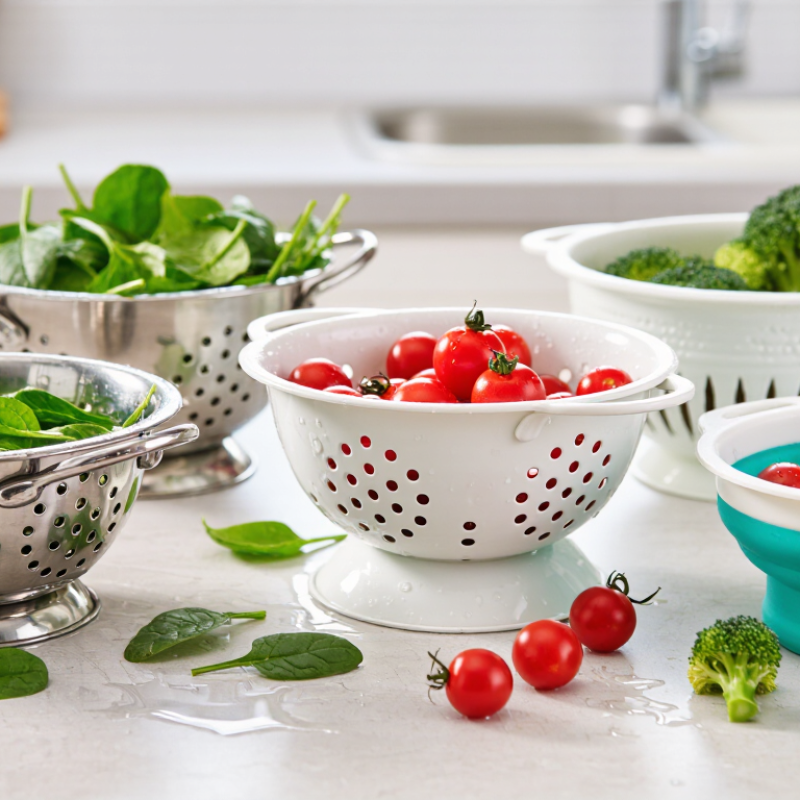
Before comparing a colander basket, define the work it must perform. A home cook may need a 2-liter basket for rinsing berries, herbs, and pasta. A restaurant kitchen may require a larger, deeper model for repeated vegetable washing. Measure your sink, storage shelf, and usual batch size. Small details matter. If the basket sits inside a pot, check its rim and base diameter, not only its total width. This prevents awkward balancing and spilled water.
Material choice should follow contact, temperature, and cleaning routines. Food-grade stainless steel offers rigidity and often handles hot draining well. Food-safe plastic can reduce weight, but heat tolerance varies by formulation. Perforation size affects drainage speed and food loss. Fine holes suit quinoa and chopped herbs; wider openings suit potatoes and larger produce. I have seen buyers focus on appearance, then struggle with trapped pulp around narrow holes. That mistake is easy to miss in a product photo.
For overseas sourcing, describe requirements in measurable language. State capacity, dimensions, material, handle length, hole diameter, packaging needs, and expected monthly quantity. Ask for samples before approving a larger order. Test one with cold berries, wet rice, and freshly boiled pasta. Check grip comfort, drainage, stability, odor, and cleaning time. Request material declarations and dimensional tolerances for your target market. My own early specification was too general. It caused avoidable revisions. Do not assume every “universal” basket fits every sink. That label needs proof.
| No. | Buying Dimension | Recommended Requirement | Practical Reason and Intended Use | Key Data or Checkpoint | Buyer Verification Method |
|---|---|---|---|---|---|
| 1 | Application Define the primary use |
Specify whether the basket is intended for rinsing vegetables, draining pasta, washing fruit, food preparation, or storage. | A basket designed for light fruit rinsing may not provide the rigidity, capacity, or heat resistance required for draining hot pasta. | Use case; food type; hot or cold operation; home or commercial environment | Prepare a written use specification and request samples for the actual application. |
| 2 | Capacity Select the working volume |
Common household sizes range from approximately 1.5 L to 5 L; larger commercial baskets may exceed 10 L. | A 2–3 L basket is suitable for smaller portions, while a 4–5 L basket is more practical for family-sized washing or draining. | Nominal volume in litres; usable volume below the rim; maximum recommended load | Measure volume with water and confirm that the stated capacity refers to usable rather than overflow volume. |
| 3 | Dimensions Match the working area |
For general kitchen use, a diameter of about 20–30 cm and a height of about 8–15 cm is a practical starting range. | The external diameter should fit the sink, bowl, dishwasher, cabinet, or preparation area where the basket will be used. | Overall length, width, height, rim diameter, base diameter, and nesting clearance | Check dimensional drawings and test the basket in the target sink, bowl, dishwasher rack, or storage space. |
| 4 | Material Choose for durability |
Typical options include stainless steel, food-contact polypropylene, food-contact polyethylene, and silicone components. | Stainless steel offers strong rigidity and heat tolerance; food-contact plastics are generally lighter and may reduce noise or scratching. | Material grade or polymer type; wall thickness; corrosion resistance; food-contact declaration | Request material documentation, inspect for corrosion or odor, and conduct hot-water and detergent exposure checks. |
| 5 | Perforation Specify hole size and pattern |
Use smaller openings for rice, berries, and small food pieces; use larger openings for pasta, leafy vegetables, and rapid drainage. | Hole geometry affects drainage speed, food retention, cleaning, and the risk of smaller items falling through. | Hole diameter; slot length and width; open-area percentage; edge smoothness | Test representative foods and inspect every opening for burrs, sharp edges, blocked holes, or inconsistent spacing. |
| 6 | Heat Performance Define temperature exposure |
For hot pasta or blanching, specify the intended water temperature and contact duration before selecting the material. | Boiling water is approximately 100°C at sea level. Plastic performance depends on the specific polymer, grade, design, and exposure time. | Maximum operating temperature; deformation limit; handle and base temperature resistance | Run a controlled hot-water test using the intended load and inspect for warping, softening, odor, or loss of stability. |
| 7 | Stability and Handling Evaluate the structure |
Select a reinforced rim, stable base or support feet, and handles that remain comfortable when the basket is wet or loaded. | Good stability reduces tipping and improves safe draining, especially when handling heavier or hot contents. | Rim rigidity; base contact area; handle strength; grip comfort; balance under load | Fill to the working capacity, lift repeatedly, place on a wet surface, and check for rocking, cracking, or handle movement. |
| 8 | Cleaning and Hygiene Minimize residue traps |
Prefer smooth surfaces, rounded transitions, accessible perforations, and designs without unnecessary crevices. | Easy-to-clean construction helps remove food residue and supports consistent hygiene during repeated use. | Surface smoothness; drainability; removable parts; dishwasher suitability; drying time | Wash with the intended detergent, inspect hidden areas, and confirm cleaning instructions through a repeated-use test. |
| 9 | Safety and Compliance Confirm market requirements |
Products intended for food contact should comply with the applicable food-contact rules in the destination market. | Requirements vary by market and material. Buyers should verify declarations, migration testing, labeling, and traceability as applicable. | Food-contact declaration; migration test reports; production-batch traceability; care and warning labels | Use an independent laboratory or qualified conformity assessment provider and verify documents against the exact material and model. |
| 10 | Packaging and Logistics Plan global shipment needs |
Use nesting or stackable designs where possible, with packaging that protects rims, handles, and perforated surfaces. | Efficient nesting can reduce carton volume and transport cost, while protective packaging helps prevent deformation and scratches. | Nested quantity; carton dimensions; gross and net weight; pallet configuration; packaging material | Conduct a packed-carton inspection and a transport simulation or drop test appropriate to the shipment method. |
Note: The dimensions and capacities above are practical purchasing guidelines rather than universal requirements. Final specifications should be confirmed through product samples, material documentation, destination-market regulations, and application-specific testing.