Welcome to this website!

Leave Your Message
- Phone
- E-mail
- Whatsapp

- Wechat

Welcome to this website!
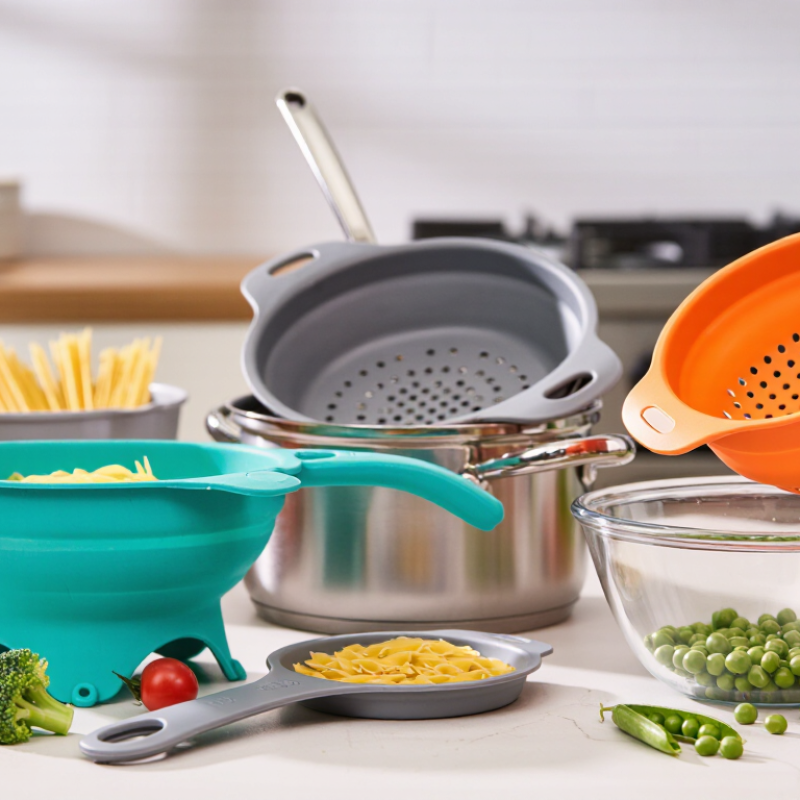
A good Silicone Strainer should make draining pasta or rinsing vegetables easier, not add another awkward tool to the sink. In 2026, shoppers can choose from collapsible baskets, clip-on designs, and flexible handheld models. Each style solves a different kitchen problem. Some save cabinet space; others sit securely over a pot or bowl. Small details matter.
This guide looks at practical features that are easy to overlook in product photos. Check the stated heat limits before using a strainer with hot cookware. Look for clear material information, sturdy handles, and openings that drain water without letting small foods slip through. A soft rim may grip a pot well, but it can feel less stable when the basket is full. That trade-off deserves attention.
We also consider cleaning and storage. Food caught around seams can take extra rinsing, while a collapsible design may be harder to dry completely if water collects in its folds. Not every kitchen needs the same shape. A compact model may suit a small apartment, while a larger basket can be more useful for family portions. There is no perfect pick.
The recommendations focus on everyday use, readable product details, and sensible care. Because designs and manufacturer guidance vary, confirm each model’s instructions before exposing it to high heat or a dishwasher. A strainer can look sturdy and still disappoint after repeated use. The best choice is the one that fits your cookware, routine, and storage space—not just the one with the most features.
2026 Best Silicone Strainer for Kitchen Use?
A silicone strainer touches hot food, oily sauces, and rinse water repeatedly. The label “food-grade” alone does not show which tests the finished product passed. FDA 21 CFR 177.2600 addresses rubber articles intended for repeated food contact; a silicone strainer’s material and intended use should be checked against the applicable requirements. Ask for documentation covering the finished article, not just a raw-material certificate. Small details matter: pigments, additives, and production conditions can affect the formulation.
The regulation sets extractives limits under specified laboratory tests. Under water extraction, the limit is 20 mg per square inch for the first seven hours, then 1 mg per square inch for the next two hours. Under n-hexane extraction, the corresponding limits are 175 mg and 4 mg per square inch. These figures come from FDA eCFR, Title 21, §177.2600(d)–(e). They are test limits, not a promise that every strainer suits every temperature, food, or cleaning method. Check the supplier’s test records and care instructions. Also inspect the rim and perforations for cracks or sticky residue; I would not keep using a damaged utensil, even if its paperwork looks complete.
| Evaluation Point | Verified Information or Practical Benchmark | What to Check When Choosing a Strainer |
|---|---|---|
| Regulatory scope | 21 CFR 177.2600 covers rubber articles intended for repeated use in contact with food. Whether a particular silicone article fits this provision depends on its materials, formulation, and intended conditions of use. | Ask for documentation identifying the applicable food-contact regulation and confirming suitability for the strainer’s intended food types, temperatures, and repeated-use conditions. |
| Aqueous-food extraction limits | For repeated-use rubber articles intended for aqueous foods, the regulation sets total extractives limits of 20 mg/in² for the first 7 hours of reflux extraction with water and 1 mg/in² for a subsequent 2-hour extraction. | These are regulatory extraction-test limits—not a consumer-use migration result or a guarantee that every product described as “silicone” complies. |
| Fatty-food extraction limits | For repeated-use rubber articles intended for fatty foods, the regulation sets total extractives limits of 175 mg/in² for the first 7 hours of reflux extraction with n-hexane and 4 mg/in² for a subsequent 2-hour extraction. | If the strainer will contact oily or fatty foods, verify that the supporting compliance documentation covers that intended use. |
| Meaning of “FDA compliant” | Food-contact compliance depends on the applicable regulations and the article’s composition and conditions of use. A statement that a product is “FDA approved” should not be treated as proof of compliance by itself. | Prefer a clear compliance statement or test documentation for the finished article; check that it corresponds to the specific material and intended use. |
| Heat-use information | 21 CFR 177.2600 does not establish one universal maximum cooking temperature for every silicone strainer. Temperature limits depend on the product’s material and manufacturer’s use instructions. | Check the stated temperature range and whether the strainer is suitable for boiling, steaming, microwave use, or dishwasher cleaning; do not infer these uses from material name alone. |
| Mesh and drainage | Mesh opening size and strainer shape are product design features, not values specified by 21 CFR 177.2600. Fine openings generally retain smaller particles but may drain more slowly. | Match the opening size and bowl capacity to typical foods: fine grains need smaller openings, while pasta and larger vegetables need ample drainage area. |
| Stability and handling | A flexible design can be convenient for storage, but stability depends on the rim, handles, support points, and the sink or bowl it rests on. | Look for a supported rim, secure handles, and dimensions that fit the intended sink or cookware. Confirm the stated load and handling instructions where available. |
| Cleaning and condition | Cleaning suitability is product-specific. Damage, persistent residue, or material deterioration can make an article less suitable for continued food contact. | Follow the care instructions, clean food-contact surfaces thoroughly, and replace the strainer if it becomes cracked, torn, sticky, or otherwise deteriorated. |
| Primary reference | Electronic Code of Federal Regulations, 21 CFR 177.2600 — Rubber articles intended for repeated use. Consult the current regulation and product-specific documentation when assessing compliance. | |